
The Case for Giving One Thing Instead of Five
Why one thoughtful gift beats five mediocre ones. A former Muji designer makes the case for giving less, choosing better, and paying more attention.
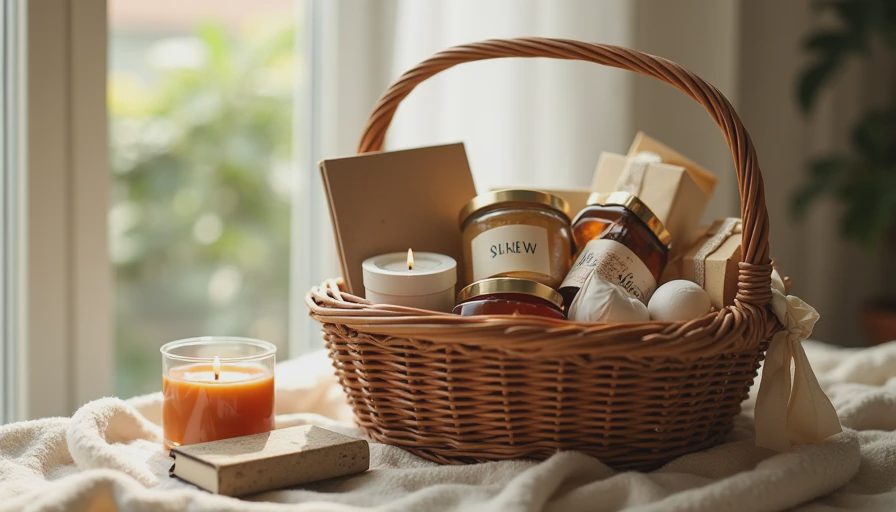
I once received a gift basket.
It was beautiful. Wicker, lined with tissue paper, filled with artisanal this and small-batch that. A candle. A jar of honey. A bar of soap. A box of tea. A tiny notebook. Five things, perfectly arranged, tied with a ribbon.
I opened it. I smiled. I said thank you.
And then I spent the next six months trying to figure out what to do with all of it.
The Problem with Plenty
Here's what no one tells you about gift baskets: they're not one gift. They're five gifts, and they're all asking you to find a place for them.
The candle was lovely, but I already have my favorite candle. The honey was delicious, but it lived in my pantry for eight months before I remembered to use it. The soap sat in my bathroom drawer because I couldn't bring myself to throw away my current bar. The tea was fine, but I drink coffee. And the notebook — beautiful, unused, still wrapped in its plastic — moved with me from Portland to our current house and has never been written in.
That's not a gift. That's an obligation.
When we give multiple things, we're not giving more love. We're giving more decisions. More clutter. More of the quiet mental work that comes from managing stuff that doesn't quite fit.
Why One Is More
I've been on the other side of this, too. Before I started Fewer & Better, I'd show up to birthdays with armfuls of carefully curated objects. I thought I was being generous. I thought more meant more.
I was wrong.
The best minimalist gift ideas aren't about what you add. They're about what you subtract. When you give one thing instead of five, you're not giving less. You're giving more of something else: attention, intention, and the gift of not having to sort through a pile.
One thing says "I thought about you." Five things says "I bought a basket."
The Math of Meaning
Let's do the math.
One gift, thoughtfully chosen, takes up one space in someone's life. It gets one spot on a shelf, one drawer, one daily ritual. It earns its keep. It becomes part of a routine.
Five gifts, even thoughtfully chosen, take up five spaces. They compete for attention. They create friction. Instead of one object that gets used every day, you have five objects that get used once — or not at all.
I learned this lesson as a product designer at Muji. We'd test products in real homes, and we'd watch what people used and what they ignored. The winners weren't the flashy products or the ones with more features. They were the ones that earned a place in the routine. The ones that made themselves indispensable.
Gifts for someone who has everything follow the same rule. You can give them five things and hope one sticks. Or you can give them one thing that doesn't need to compete.
The Gift of a Single Decision
Here's something I've noticed about people who give multiple gifts.
They're often anxious. They're not sure which one will work, so they hedge their bets. They give three candles because they don't know which scent you'll like. They give a set of notebooks because they're worried the first one isn't enough.
The message this sends isn't "I love you." It's "I didn't know what you'd want, so I gave you everything."
A single gift says something different. It says "I know you." It says "I paid attention." It says "I made a choice."
That's what we're really giving when we give a gift: not the object, but the evidence that we see someone clearly. And that evidence is diluted when it's spread across five things.
The One-Question Rule
Before I buy any gift now, I ask myself one question.
If I had to give just one thing, and only one thing, what would it be?
This question cuts through the noise. It forces me to pay attention. It forces me to choose. It forces me to stop shopping like I'm filling a basket and start giving like I'm honoring a person.
Sometimes the answer is a single, perfect object. Sometimes it's an experience. Sometimes it's nothing at all. But it's never five things in a basket.
Give less. Mean more. That's not just a tagline. It's a practice of paying attention. It's a choice to give one thing that matters instead of five things that don't.
The next time you're reaching for a third, fourth, or fifth thing, stop. Ask yourself: is this making the gift better — or just bigger?
Because the gifts that last aren't the ones with the most pieces. They're the ones with the most presence.
And that's something you can't put in a basket.
Comments
No comments yet — be the first to share a thought.