Why I Left Muji to Teach People How to Give Less — A Manifesto
Former Muji product designer Lena Norwood explains why she left the world of making things to teach people how to give less — and mean more. A manifesto for intentional gift giving.
I spent six years asking one question so many times that it became a kind of prayer.
Does this object deserve to exist?
At Muji, that question wasn't rhetorical. It was practical. It was the thing we returned to when a sketch felt promising but we weren't sure why. It was the thing we asked when a product survived three rounds of prototyping and still didn't feel done. It was the thing I whispered to myself at 2 a.m. in the studio, staring at a line of stationery that was perfectly functional and somehow still unnecessary.
Most days, the answer was no. And on those days, we killed the product. We drew a line through it, moved on, and never spoke of it again. That was the job.
But the question followed me home.
The Weight of the Wrong Gift
When I left Muji in 2019, I opened a small design studio in Portland, Maine, called Fewer & Better. I started making a handful of objects each year — slowly, in small batches. And I started noticing something strange.
Everywhere I went, people kept asking me the same question. Not about what to design. About what to give.
What do I get for someone who already has everything?
What's a meaningful gift for a minimalist?
How do I show I care without adding to the pile?
These weren't people who didn't care about gifts. They were people who cared too much. They'd watched too many presents get unwrapped, acknowledged, and quietly relegated to a closet or a donation box within six months.
They were people who wanted to give intentional gifts — gifts that actually landed. They just didn't know how.
What I Learned About Objects
At Muji, I learned that most objects don't need to exist. They're designed to fill a gap on a store shelf, not a gap in someone's life. They're made to be bought, not kept. And when we give those objects as gifts, we're passing along something that was never meant to last.
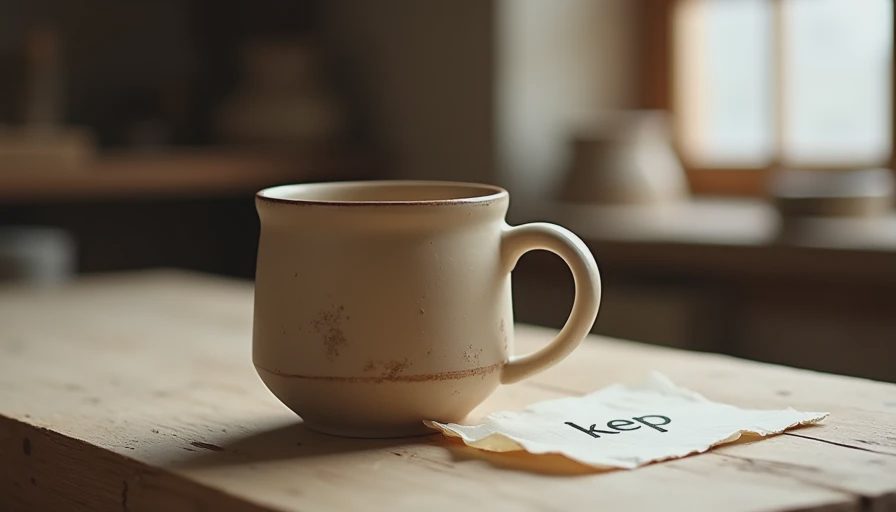
I also learned what makes an object worth keeping. It's not about price. It's about whether it passes three tests: Form — does it feel good to look at and hold? Function — does it do its job without fuss? And Feeling — does it connect to something real? A gift that passes all three tests is a gift that stays.
Most gift-able products fail at least one. That's why they end up in donation boxes.
That's why I started paying attention to minimalist gift ideas not as a category of products, but as a way of thinking about what we give. The question is never "what should I buy?" It's always "what is worth giving?"
The Gift That Leaves Space
Here's what I came to believe: the best gifts don't fill shelves. They leave space.
Space to breathe. Space to be. Space to simply be with the person you're giving it to.
That's not less love. That's less stuff. And that's what I want to teach people.
Give less. Mean more. That's not a reduction. It's a recalibration. It's moving the effort from searching to considering. From buying to choosing.
A gift that takes up zero space can mean more than something wrapped in expensive paper. The most meaningful gifts that aren't things are the ones that ask nothing of the recipient — no shelf space, no dusting, no guilt. They just stay.
Why I'm Writing This
I left Muji because I wanted to make fewer things — and make them better. But I started this blog because I realized something else: the question I asked a hundred times a week at Muji is the same question we should all be asking before we give a gift.
Does this object deserve to exist — in someone's home, in someone's life, in someone's memory of you?
If the answer is yes, give it. If it's not, give something else. Or give nothing at all.
Sometimes the kindest gift is respecting someone's space. That's what I've learned from years of asking the hard questions about objects, and from watching how people struggle with giving the right thing to the people they love.
That's what this blog is about. I'm not here to judge you for wanting to give things. I'm here to share what I've learned: you can express love with less.
Welcome to Fewer & Better.
I'm Lena. I used to design things to be wanted. Now I help people give things worth keeping.
Give less. Mean more.
Comments
No comments yet — be the first to share a thought.